
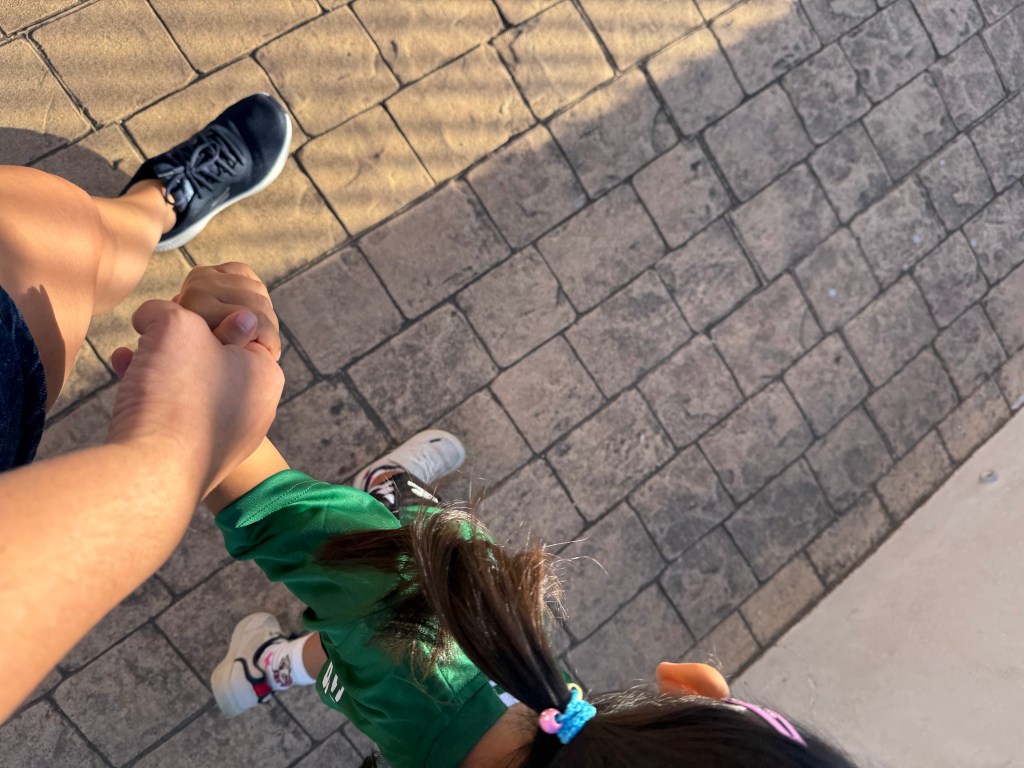
Moving to a different country with a young child brings excitement but also questions and worries about the unknown—specifically around language. My daughter was already bilingual, a native speaker in both English and Spanish. The move hasn’t been about learning a new language, but about learning when and how to use each one, as well as maintaining the language that is no longer dominant. I have seen incredible changes that remind me just how flexible a young child’s brain is. She subconsciously compartmentalizes languages: we speak only English at home to keep it strong; she mixes English and Spanish on the street when she and I interact, making Spanglish our main language with each other outside the home, and she switches seamlessly to Spanish when speaking with locals.
One of the most remarkable things has been how quickly she picked up local expressions, words, and colloquial language, much different than what she was accustomed to. Even within the first weeks, she began using words and phrases that felt natural to her new environment. Now, fully immersed in school, she uses vale and vosotros, and of course coger, which led to smiles and giggles when she was yelling it in Mexico over the summer.
Of course, this process isn’t without its quirks. Sometimes she spontaneously switches languages mid-sentence, especially in Spanglish moments that leave me both laughing and marveling at her skill. The challenge is keeping English strong at home while letting Spanish flourish naturally outside, without making either feel forced.
Over time, I’ve found approaches that make bilingual life feel effortless for both of us. Keeping English-only consistent at home gives her a reliable base for the language, while I have let all things Spanish fall to school and the outside world. I rarely speak to her fully in Spanish anymore in order to model English and Spanglish (as it is also very important for her to understand the nuance and cultural importance of this way of speaking). Books and shows reinforce English, not just in her understanding of the language, but for another form of accent modeling and culture-learning so she can seamlessly transition between the multiple cultures and countries she is now a part of.
Raising a bilingual child isn’t about perfection. It’s about creating environments where each language has purpose and meaning, supporting children as they intuitively navigate multiple worlds, because their brains are capable of so much. With patience, consistency, and real-life practice, children can thrive across languages without giving up skill, understanding or accent in any language.
At Españaula, we guide families through the realities of multilingual life, helping children and parents thrive in both school and daily life in Spain.




 Españaula Blog: Your Guide to Schools & Education in Málaga & the Costa del Sol
Leave a comment